
STWIN aims to eliminate defects in the welding process by exploiting the specific advantages of the friction stir welding process in combination with real-time quality control and AI
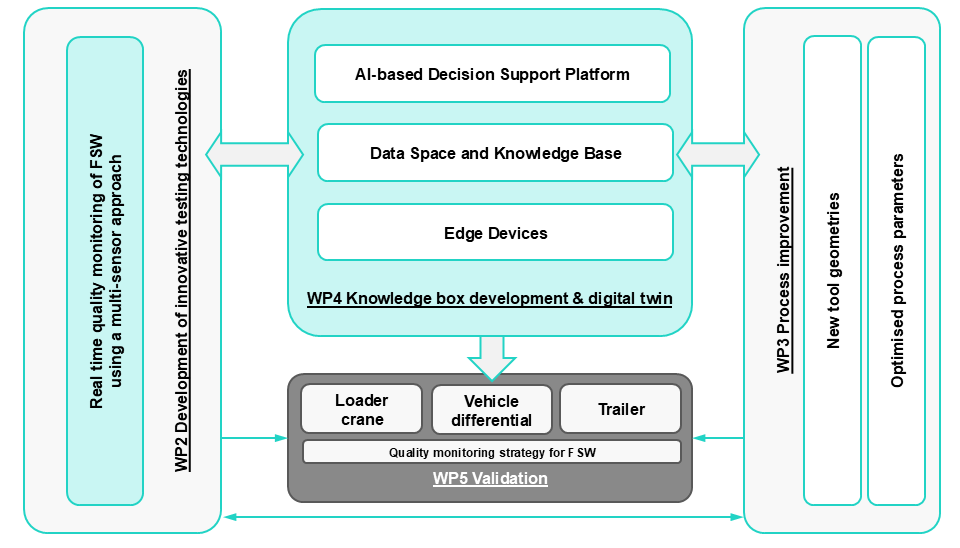
STWIN aims to join high-strength steels and dissimilar materials, as well as materials of different thicknesses, using friction stir welding (FSW). To achieve this, the project follows a four-phase approach combining process monitoring, artificial intelligence, manufacturing optimisation and industrial validation:
- Real time quality monitoring for friction stir welding
STWIN will develop and demonstrate an advanced real-time monitoring system for FSW. The system will combine key process parameters, such as rotational speed and welding forces, with complementary measurements obtained through an integrated multi-sensor approach. This will provide a basis for monitoring process behaviour and assessing weld quality during manufacturing.
- Development of AI models and a digital twin
A digital twin provides a digital representation of a physical process, linking data from the real-world to its digital counterpart. STWIN will develop a digital twin for FSW supported by artificial intelligence (AI) and machine learning models. This approach will enable real-time process analysis, predictive capabilities and data-driven optimisation.
- Manufacturing process optimisation
STWIN will evaluate and further improve FSW tools for steel joining applications. New tool geometries will be designed and assessed to improve joint mechanical properties and extend tool life. The work will also investigate process parameters to support reliable welding of complex geometries and dissimilar material combinations.
- Demonstration and industrial validation
The developed methods and optimisation strategies will be demonstrated and validated through three industrial use cases: high-strength steel joints for crane applications, complex geometries for automotive applications and aluminium-to-steel joints for trailer applications.